



Helping Children Understand and Follow Verbal Instructions
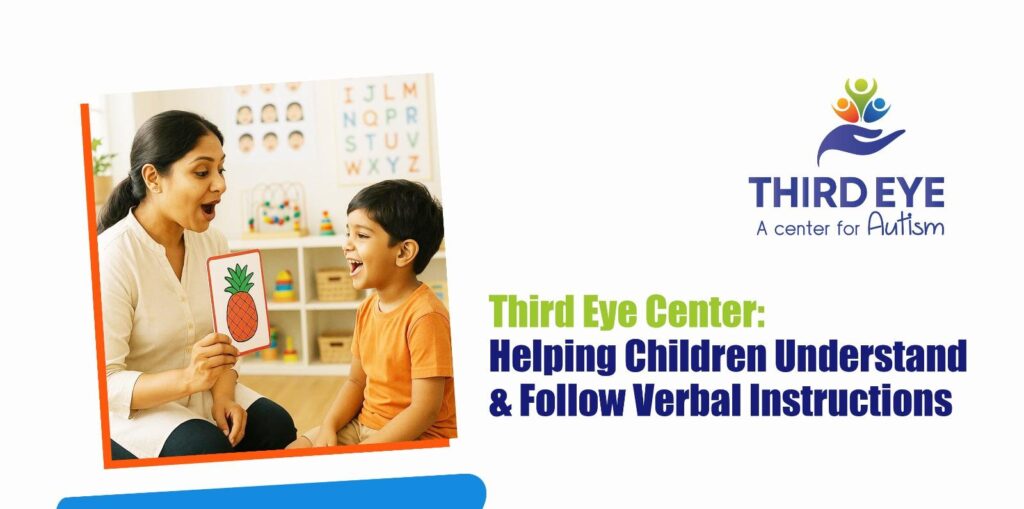
Children encounter spoken instructions every day: “Come here,” “Keep the book on the table,” or “Put your shoes away.” Following an instruction asks a child to listen, understand the words, remember what to do and carry out the action.
For some children, these steps can be difficult, especially when instructions are long or unclear, or when the environment is distracting. With patient, individualized support, children can practise these skills in ways that build on their strengths and needs.
Third Eye Center supports children through an autism-specific educational approach that recognizes each child's abilities and individual learning needs.
Why Do Some Children Find Verbal Instructions Difficult?
Understanding and following spoken directions involves several skills. A child may need to:
- Pay attention to what is being said.
- Understand the words and what the instruction means.
- Process and remember the information.
- Sequence the steps and carry out the action.
- Ask for clarification when something is unclear.
How Third Eye Center Supports Learning
Learning can be adapted to each child's abilities and needs. An individualized approach builds on a child's strengths, supports their learning and gives them opportunities to practise skills in meaningful activities.
1. Break Instructions into Smaller Steps
A long instruction can be confusing. Breaking an activity into short, manageable steps gives a child one action to focus on at a time.
Instead of: “Get your bag, open it, take out your notebook, and put it on the table.”
Try:
- Get your bag.
- Open your bag.
- Take out your notebook.
- Put it on the table.
2. Use Clear and Simple Language
Short instructions using familiar words can help a child focus on the important information. Give the child time to process what they have heard before repeating or adding another instruction.
3. Support Attention and Listening
Before giving an instruction, it may help to get the child's attention in a calm, respectful way. Speak clearly, use the child's name if appropriate, and reduce competing distractions where possible. The goal is to support understanding and response, not simply to have a child repeat the instruction.
4. Use Visual Support
Some children find spoken information easier to understand when it is paired with visual support, such as:
- Pictures or objects
- Written words
- Demonstrations
- Visual schedules
- Step-by-step activity cards
Combining verbal and visual information can make the steps of an activity clearer.
5. Encourage Independent Responses
As a child becomes familiar with an instruction, gradually reduce the amount of help while allowing enough time for them to respond. Practising familiar tasks this way can help children use developing skills in everyday life.
Everyday Situations Where Verbal Instructions Matter
Children can practise listening and responding in familiar routines and activities.
| Situation | Example instruction |
|---|---|
| Home | “Put your toys in the box.” |
| School | “Open your notebook.” |
| Personal care | “Wash your hands.” |
| Play | “Pass the ball to your friend.” |
| Travel | “Come here and stand beside me.” |
| Classroom activity | “Colour the picture.” |
Supporting Children Without Pressure
Children learn in different ways and at different paces. If a child does not respond straight away, repeating the same words several times may not be helpful. Instead, try to:
- Allow extra time to process the instruction.
- Give one instruction at a time.
- Use a visual cue or demonstrate the task.
- Offer support that suits the child and activity.
- Practise in familiar, everyday situations.
Quick Tips for Parents
- Keep instructions brief and simple.
- Use familiar words and a calm voice.
- Reduce distractions when possible.
- Give your child time to respond.
- Use visuals or demonstrations when helpful.
- Notice and encourage effort.
- Practise one skill at a time during regular routines.
Frequently Asked Questions
Why does my child struggle to follow verbal instructions?
Children may find instructions challenging for different reasons, including attention, understanding, memory or sequencing. A qualified professional can help identify what support may be useful for your child.
How can I make instructions easier for my child?
Try short sentences with one step at a time, reduce distractions, demonstrate the activity and use visual cues when helpful. Allow time for your child to process and respond.
Can visual instructions help?
Visual supports may help some children because they provide information that can be looked at again after an instruction is spoken. The most useful supports depend on the individual child.
How can Third Eye Center support my child?
Third Eye Center offers an autism-specific educational setting and an approach that aims to build on each child's strengths and individual learning needs. Contact the team to discuss your child's needs and available support.
Conclusion
Understanding and following spoken instructions can help children take part in classroom activities, communicate their needs and manage everyday routines. With clear language, appropriate support, practice and time, children can build these skills at their own pace.
Third Eye Center works to understand each child and support their learning and development.
If you have concerns about your child's development, consider discussing them with your healthcare provider or a qualified child-development professional. You do not need to have all the answers before asking for guidance.
